The fascination of radio: where it all began…
There is a moment in every amateur radio operator’s life that is never forgotten. For me, it was an afternoon when I was a child, with a walkie-talkie in my hands. It was not just a toy — it was a window onto the world. The discovery that my voice could travel through the air, invisibly, and reach someone on the other side without wires, without cables, without anything physical connecting us. Just radio waves.
That feeling of pure magic — something almost impossible to explain today to anyone who grew up in the age of WhatsApp — was the seed that grew into more than 40 years of passion for radio.
Citizens Band: radio for everyone
The next step was natural and inevitable: Citizens band A group of nearby frequencies used for the same purpose, like a lane on a motorway., the legendary 27 MHz Megahertz, millions of vibrations per second: the unit used to measure frequency. CB radio.
During the 1980s and 1990s in Italy, CB was a real cultural and social phenomenon. Truck drivers, hobbyists, young people, curious listeners — everyone had a microphone in hand and everyone tuned to the same frequencies. It was a real community made of voices and nicknames, long before social networks invented digital communities.
My first “serious” radio was the President Lincoln CB — a transceiver A radio that can both receive and transmit. that, for my generation, carries the same sentimental value that a Fender Stratocaster has for a guitarist.
Its distinctive design, solid construction and, above all, its SSB A voice mode widely used by radio amateurs on shortwave. (Single Side Band) capability opened up a completely different world. Thanks to single-sideband operation, the voice could travel much farther than normal, far beyond the usual local CB channels.
Then came that moment: my first SSB contact with a French radio operator.
It was an unforgettable experience. It was no longer a local conversation between nearby stations — a border had been crossed. Another country. Another voice replying from hundreds of kilometres away through the open ether.
That was when I understood: this was not simply a hobby. It was a calling.
1993 — IW6OWU is born: the licence and my first real station
In 1993 I made one of the most important decisions of my amateur radio life: obtaining my amateur radio licence.
It was not something to be taken lightly. It required serious study and months of preparation covering electronics, radio-wave propagation The way radio waves travel through the air. and international regulations.
But every hour spent studying was worthwhile.
The call sign Every radio amateur’s personal “number plate”, like IZ6CLV. assigned to me was IW6OWU — District 6, Abruzzo.
My identity on the air.
Even today, hearing that call sign still brings back strong memories.
My first true amateur radio transceiver A radio that can both receive and transmit. was an ICOM IC-706: all-mode, covering the HF Shortwave, between 3 and 30 MHz, which can reach the other side of the world. bands as well as VHF The frequencies between 30 and 300 MHz, home to FM radio and aircraft, for example., compact yet extraordinarily capable.
Even today, more than thirty years later, the IC-706 is still regarded as a landmark radio. It influenced an entire generation of amateur radio operators thanks to its remarkable balance between performance and size.
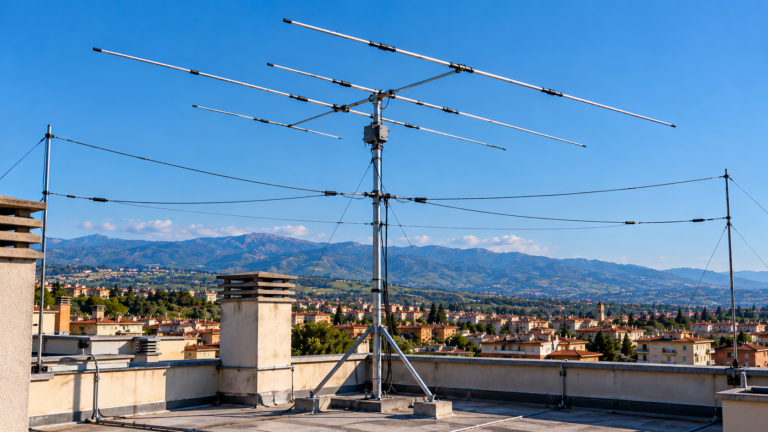
It was connected to an ECO 3-element directional HF antenna and a KLM 13-element VHF/UHF antenna, installed on a six-metre tower with a Yaesu rotator.
For the first time, the station offered what every radio amateur dreams of: a directional signal, real gain How much an antenna or amplifier “boosts” the signal. and the very tangible difference between struggling to be heard and receiving a solid 59 signal report.
Rome, IW0EOD and the decisive turning point in 2003
Life later took me to Rome.
The Ministry of Communications assigned me the temporary call sign Every radio amateur’s personal “number plate”, like IZ6CLV. IW0EOD — District 0, Lazio.
Operating from a large city like Rome presented completely different challenges: electromagnetic interference everywhere, limited space for antennas and propagation The way radio waves travel through the air. affected by the urban environment.
But every difficulty was also an opportunity to learn.
Then, in 2003, came the turning point I had been waiting for: the full amateur radio operating licence, including the theoretical examination and — most importantly — the practical CW Morse code sent by radio. Morse code examination.
At that time, the Morse requirement was still internationally relevant, and Italy continued to maintain it even after changes at international level.
Learning to transmit and receive Morse code was not simply a bureaucratic requirement.
It was a profound experience.
It is the same language used by Guglielmo Marconi, by sailors in the middle of the ocean and by the pioneers of radio.
Every dot and every dash carries more than a century of telecommunications history.
From that moment, my definitive call sign became:
IZ6CLV
The call sign I still use today from Cellino Attanasio, in the province of Teramo, Abruzzo.
Today: YAESU FT-DX10, the Prosistel “Cornuta” and digital modes
The station I use today represents an extraordinary technological leap compared with my first ICOM station in 1993.
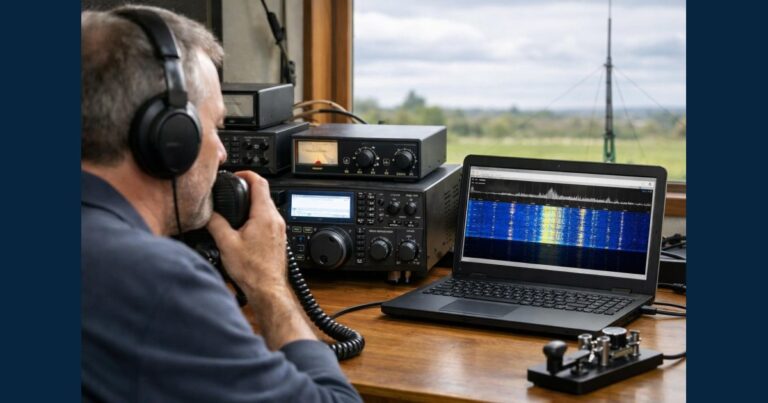
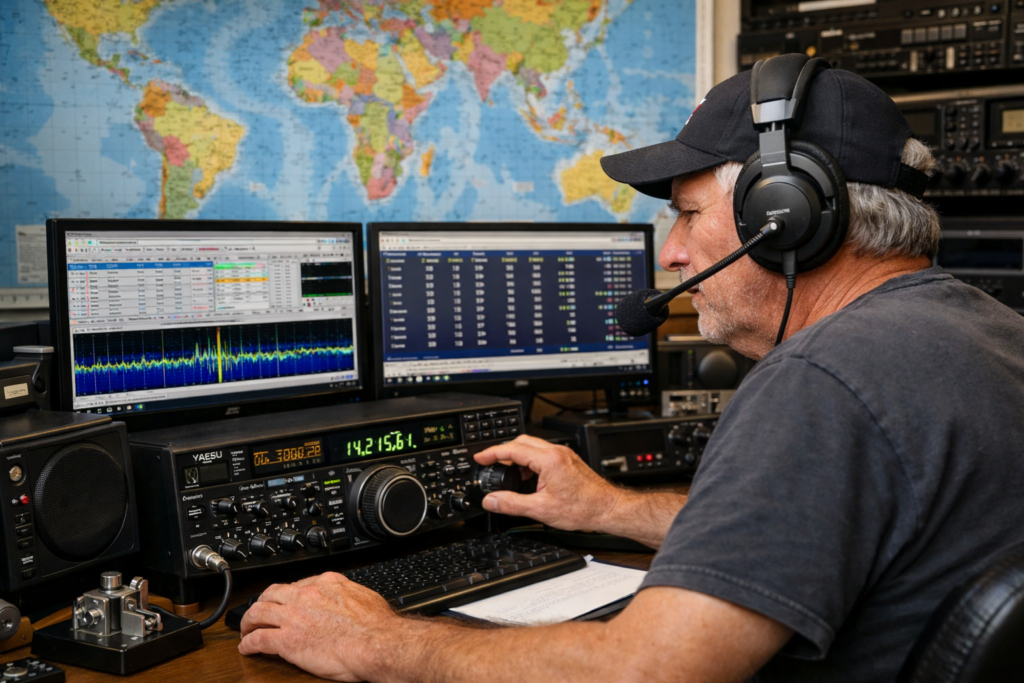
The YAESU FT-DX10 is a 100-watt hybrid SDR A radio where most of the work is done by software on a computer. transceiver A radio that can both receive and transmit. with advanced DSP A small computer inside the radio that cleans up the sound and removes noise. filtering and a colour display capable of showing the radio spectrum The “map” of frequencies, where each signal shows up as a line or a small hill. in real time — something that would have been almost unimaginable thirty years ago.
My main antenna is the Prosistel PST-1524TV “Cornuta”, a trapped dipole A simple antenna made of two equal arms, one on each side. covering the 10, 15, 20 and 40 metre bands.
It is compact and suitable even where installation space is limited, making it ideal for my QTH The place you transmit from. at approximately 415 metres above sea level in Cellino Attanasio.
A multiband HF Shortwave, between 3 and 30 MHz, which can reach the other side of the world. vertical antenna completes the system, also covering the WARC bands — 17, 12 and 30 metres — bands traditionally free from major contests, quieter and ideal for relaxed QSOs and longer conversations.
The amateur radio world has changed enormously over these forty years.
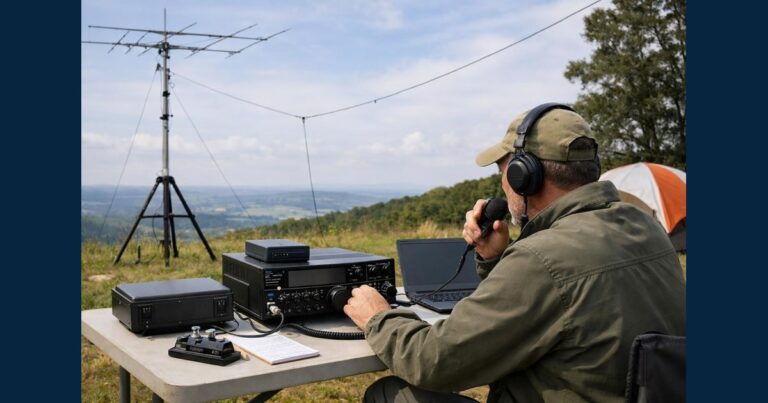
Digital modes such as FT8 A digital mode: the computer sends and receives short messages even with very weak signals. and FT4 have transformed HF operation. Today, with only five watts and a modest antenna, it is possible to work stations on five continents.
Log4OM manages the station log automatically, while WSJT-X can decode Turn the signal into text, pictures or sound you can understand. signals that are almost impossible for the human ear to detect.
QSL A confirmation of a contact, often a postcard. confirmations can arrive within seconds through LoTW ARRL’s online system for confirming contacts., instead of taking weeks through traditional postal mail.
And yet, despite all this technology, the excitement of making a new contact has remained exactly the same.
Technology changes.
The magic does not.
Conclusions
In an age in which communication has become almost effortless — one tap on a screen and you are connected to the other side of the world — radio still retains a fascination that cannot be reproduced.
Every contact still feels earned: the right propagation The way radio waves travel through the air., the antenna pointed in the right direction, the correct timing.
And on the other side there is always a real person, with a call sign, a QTH and a story.
IZ6CLV – Guido