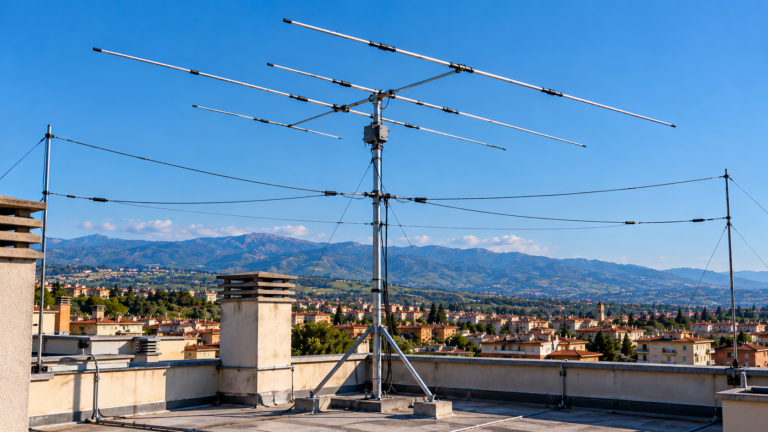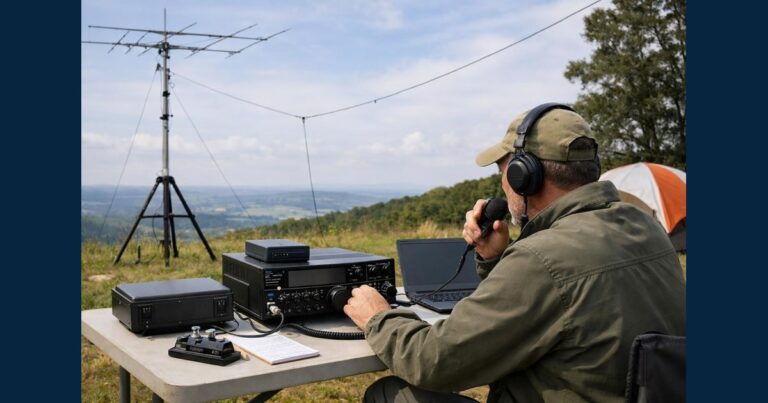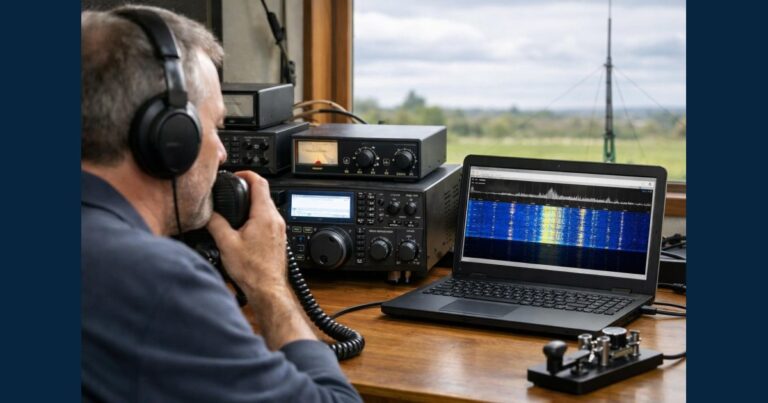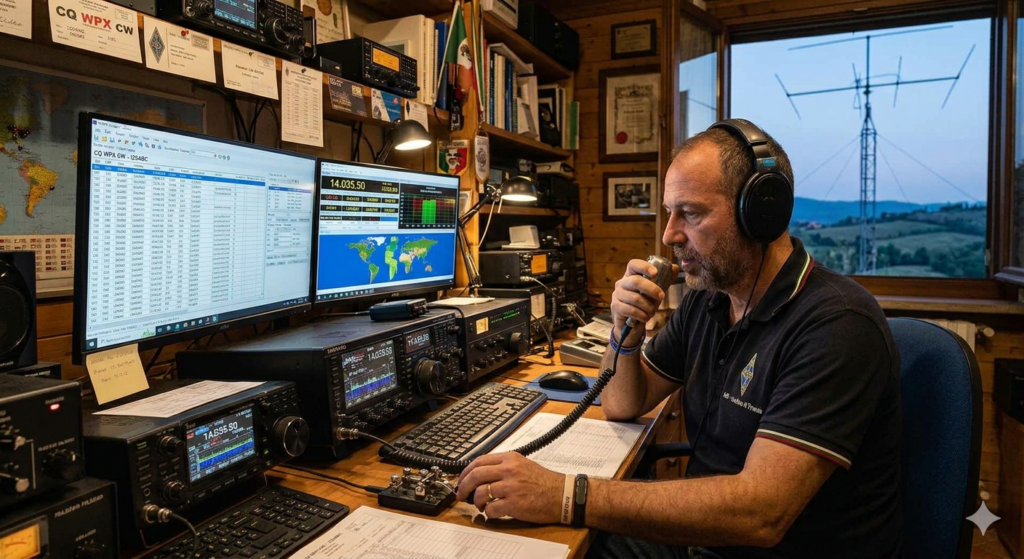
Have you ever dreamed of becoming an Amateur Radio Operator and communicating with people all over the world using radio waves, taking part in international contests, or simply exploring the vast and fascinating world of radio technology? Becoming an amateur radio operator (or “ham radio operator”) is a rewarding and technical hobby that opens the door to a global community and endless possibilities for experimentation.
This guide will take you step by step through the entire process required to obtain your amateur radio licence in Italy.
Tuning is not luck; it is the patience of those who know how to listen to silence until it becomes a voice.
What does an Amateur Radio Operator do?
An amateur radio operator is a person authorised to transmit on specific radio frequency The “channel” a station transmits on. bands for non-commercial purposes. These purposes include technical experimentation, self-training, interpersonal communication and, crucially, providing communication support in emergency situations.
The activities are varied:
DXing: Making long-distance radio contacts (other continents).
Contesting: Taking part in competitions to make the greatest possible number of contacts within a limited period of time.
Experimentation: Building antennas and testing new digital transmission modes.
Satellite Communications: Using amateur radio satellites to communicate.
Civil Protection: Providing communication support during natural disasters.
Basic Requirements
In Italy, anyone can become an amateur radio operator, regardless of citizenship, provided they reside within the country. There is no age limit for taking the examination, but the licence and subsequent authorisation are issued only from the age of 14. Under the age of 14, it is possible to operate under the supervision of a licensed amateur radio operator.
The Step-by-Step Process
Obtaining amateur radio operator status requires time and study. These are the main stages:
1. Preparing for the Examination (Study)
The examination required to obtain an amateur radio licence is the main hurdle. It should not be underestimated: it requires a good basic knowledge of electronics, radio theory, national and international regulations, and operating procedures.
How should you prepare?
Self-study: You can purchase specialist textbooks. One of the most widely used and appreciated is Il Manuale del Radioamatore (often associated with N. Neri).
Organised Courses: Many local branches of ARI (Associazione Radioamatori Italiani) and other associations organise preparation courses. This is often the best choice because it gives you the opportunity to ask questions to experienced amateur radio operators, practise with equipment and meet other enthusiasts. Courses usually last a few months.
The examination programme covers:
Basic electrical engineering: Ohm’s law, resistors, capacitors, inductors.
Electronics: Transistors, vacuum tubes (although less common today, the theory is still required), oscillator circuits, amplifiers.
Radio theory: Types of modulation The way voice or data is “loaded” onto the radio wave. (AM A way of sending a voice by changing the strength of the signal., FM A way of sending a voice by changing the frequency slightly., SSB A voice mode widely used by radio amateurs on shortwave., CW Morse code sent by radio., digital modes), radio-wave propagation The way radio waves travel through the air., antennas and transmission lines.
Regulations: Electronic Communications Code (Legislative Decree 259/2003 and subsequent amendments), emergency procedures, frequency The “channel” a station transmits on. allocation.
Note: Until 2016 there were two licence classes (A and B). Today there is a single licence that grants access to all amateur radio frequencies, including CW (Morse code), although the examination no longer requires a telegraphy test.
2. Submitting the Examination Application
The examination is managed by the Territorial Inspectorate of the Ministry of Enterprises and Made in Italy (MIMIT) responsible for your region.
You will need to:
Check the dates of the examination sessions on the MIMIT website or through your local ARI branch. There are usually two sessions each year.
Complete the application form for admission to the examination.
Attach the required documentation (often a copy of your identity document, passport photographs and revenue stamps).
Submit the application within the specified deadline (often several weeks before the examination date).
3. Taking and Passing the Examination
The examination usually consists of a written multiple-choice test (60 questions to be completed within a limited period of time). Once you have achieved a sufficient score, you may be asked to take an optional oral examination, at the discretion of the examination board, usually to confirm the result or if the written score is borderline.
4. Obtaining the Amateur Radio Operator Licence
Once you have passed the examination, the Territorial Inspectorate will send you the Amateur Radio Station Operator Licence by post. This document certifies your technical eligibility to operate.
5. Applying for a Station Call Sign
The licence alone does not authorise you to transmit. You need a unique call sign Every radio amateur’s personal “number plate”, like IZ6CLV. that identifies you worldwide.
Complete the application for the assignment of a call sign.
Send the application to the same Territorial Inspectorate.
You will receive your call sign (e.g. IW1XXX, IZ2XXX). The prefix (IW, IZ, etc.) and the number identify your geographical area in Italy.
6. Applying for the General Authorisation (AG)
The General Authorisation (AG), formerly known as the Station Licence, is the document that authorises you to install and operate your amateur radio station for 10 years (renewable).
Submit the notification of commencement of activity (the AG form) to the Territorial Inspectorate once you have obtained your call sign.
An annual fee of €5.00 is required (subject to very rare regional variations or future updates to the Electronic Communications Code).
When: By 31 January (or with a small surcharge if payment is made shortly afterwards).
How: Through the DGST payment portal of the Ministry of Enterprises and Made in Italy or through the channels specified by the Territorial Inspectorate of your region.
Furthermore, if until now you have made payments by direct bank transfer to the postal current account dedicated to the relevant service, please note that, pursuant to Circular No. 28 of 26 October 2023 – RGS Prot. 249626, all postal current accounts registered to the former Provincial State Treasury Offices were closed on 30 June 2024.
Therefore, do not make any further bank transfers or direct payments to those accounts, in order to avoid the transaction being rejected because the accounts have been closed.
Useful Links:
Online service for applications and renewals of the General Authorisation for amateur radio operators:
https://appradioamatori.invitalia.it
For specific technical matters, you can send an email to:
info.radioamatori@mise.gov.it
For matters concerning an individual administrative procedure, contact the Territorial Inspectorate of your region of residence:
https://ispettorati.mise.gov.it