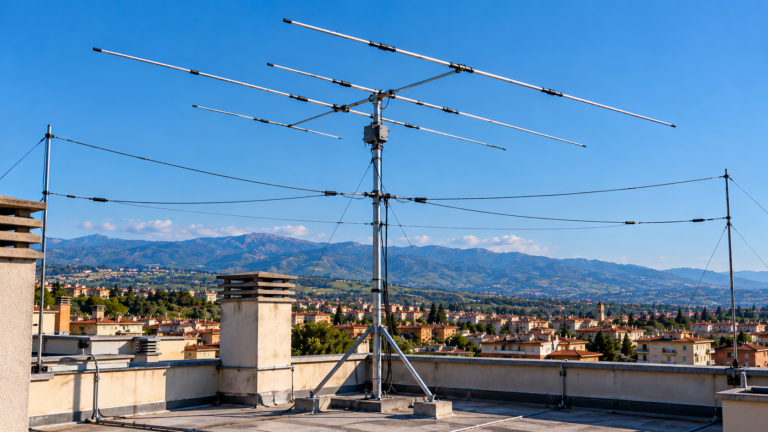
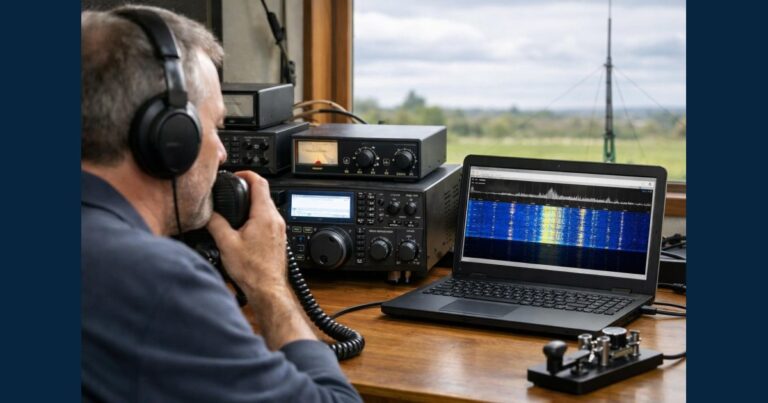
Amateur radio today makes sense if you’re interested in how communication works, not just in getting a message to its destination. For everyday chats, the Internet is more convenient. Radio, by contrast, involves making contacts, listening, working with technology and communicating without relying on commercial networks.
The right question: communicating or doing radio?
If your goal is to send a message to someone you know, WhatsApp and other online services are usually the quickest option. There’s no need to install an antenna, find a frequency The “channel” a station transmits on. or work out why a contact succeeds at one time and not another. A phone solves that problem in a few steps.
For many radio amateurs, though, the result is only part of the appeal. The process matters too: setting up a station, choosing a transmission mode, listening, calling and finding out whether the signal gets through. Amateur radio isn’t a less practical kind of chat. It’s an activity where the communication method itself is part of the experience.
This difference helps set expectations. If you mainly want quick communication with friends and family, radio may not be a convenient substitute for a phone. But if you enjoy technology, listening and making contacts over the air, amateur radio offers a hobby with a range of different goals. The ARRL describes the amateur radio service as an activity that includes communication, learning and experimentation.
For a broader look at the role and activities of radio amateurs, see also who amateur radio operators are and why they can be useful.
What happens between the antenna and the other station
With a chat app, you see the text you send and the reply you receive; the networks that carry the data remain mostly out of sight. In amateur radio, several parts of the contact become part of the activity. You can consider the station, antenna, power used and propagation The way radio waves travel through the air. conditions, and see how they affect the chances of being heard.
Distance, then, isn’t solved simply by selecting a contact from your address book. A signal may reach a distant station, or it may not be received as expected. Propagation conditions and the antenna system both contribute to the result, along with the other parts of the station. A regular messaging app removes this uncertainty for the user, but for many radio amateurs it’s part of what makes a contact interesting.
Each completed contact gives you a clear result: another station received your signal and replied. When a contact doesn’t work, there’s something to investigate. There isn’t always a simple answer, and it’s not right to blame every failure on a single component. Over time, though, you can learn to distinguish the variables involved and assess your choices more accurately.
Radio also offers different modes. Some enthusiasts prefer voice; others focus on digital modes or listening. You don’t have to do everything. A radio amateur can choose one area and explore it in depth, or change interests depending on the equipment, available space and time.
From a home station to outdoor activities
The image of a radio amateur at a large home station doesn’t cover all the options. Some operate from home, some take their equipment outdoors, and others spend most of their time listening or experimenting. Activities also depend on what you want to achieve: making contacts, taking part in a contest A competition between radio amateurs to make as many contacts as possible in a set time., working on an antenna or monitoring received signals.
Available space can influence your choices, but it doesn’t determine by itself whether amateur radio is right for you. If you don’t have room for a large setup, you can start by exploring the activities that interest you and considering realistically what’s possible where you live. You don’t need to build a complete station before you know which part of radio appeals to you.
For those who prefer being outdoors, some amateur radio activities take place outside and in groups. The ARRL Field Day, for example, is presented as an opportunity to transmit, experiment and work together without relying on commercial systems. That doesn’t mean every outing has to be an emergency exercise or a competition. It can simply be a different way to test a station and learn from others.
Variety matters in amateur radio because you can change your goals without changing hobbies. You might move from using a fixed station to operating outdoors, or focus on listening and the technical side. The motivation might be a difficult contact, or the gradual work involved in understanding a setup or transmission mode better.
Independent communications: possibilities and limits
One practical feature of radio is the ability to communicate without the contact depending, at that moment, on a phone network or commercial Internet service. It’s useful to understand this capability, but it doesn’t mean you can always reach anyone. Radio has technical limits and depends on the conditions of the link; it doesn’t guarantee that a message will get through.
In emergencies, prepared amateur radio networks can support communications when some phone and commercial infrastructure is damaged or overloaded. The ARRL and IARU The international union of radio amateur associations. describe organized activities where preparation and coordination matter. Owning a radio isn’t enough to be ready for that role, and having equipment doesn’t guarantee a service will be available to those who need it.
For radio amateurs interested in this area, the distinction matters: potential technical capability isn’t the same as an organized network. Operational experience, preparation and coordination are part of the work done by the associations and volunteers involved. Without these elements, it’s best not to present a personal station as a guaranteed alternative to public communications.
That’s why amateur radio shouldn’t be bought or studied solely as an emergency tool. If there’s no everyday interest, owning a radio doesn’t create skill or reliability by itself. It makes more sense to treat independent communication as one of the possibilities radio offers, and to develop it with suitable preparation when it’s a genuine goal.
When radio may be worth the time it takes
Radio may suit people who want to understand how a contact is made and aren’t satisfied with simply pressing “send”. It may also appeal to those who enjoy listening, technical experimentation and connecting with other enthusiasts. For some, part of the attraction is the unpredictability: signals don’t always behave as expected, which encourages closer attention to the system.
Radio amateurs don’t all need the same motivation. Some focus on long-distance contacts, others take part in contests, build or modify antennas, or explore digital modes. The variety helps you find your own direction, but it also guards against a mistaken assumption: a handheld radio or a repeater An automatic station, often on a hill, that receives and re-sends signals so they reach further. doesn’t cover everything you can do with radio.
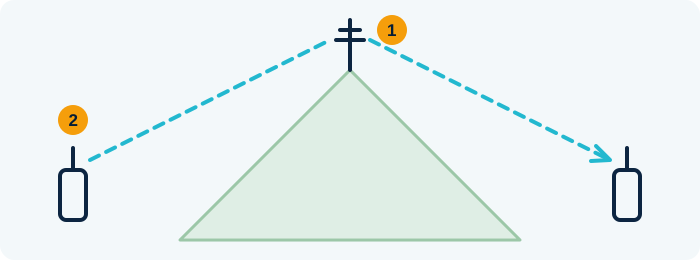
- The repeater on the mountain hears on one frequency and retransmits on another (the “shift”)
- Two radios that can’t hear each other talk through it
Teaching illustration created by RadioMeteo.
A practical approach is to start with a specific question. Do you want to talk over the radio? Are you more interested in how an antenna works? Would you rather listen before transmitting, or take part in organized activities? The answers can help you choose what to explore, without buying equipment based on the vague idea that you need “a radio”. It’s also a useful way to see whether the time involved fits your routine.
Messaging remains the best tool for many everyday communications. There’s no need to deny its convenience to make a case for amateur radio. For radio amateurs, the point is often different: turning a contact into something to understand and improve. If that interests you, the Internet hasn’t made amateur radio obsolete. If you simply want the easiest way to communicate, a phone may be enough.