A passion that goes far beyond simply talking on the radio
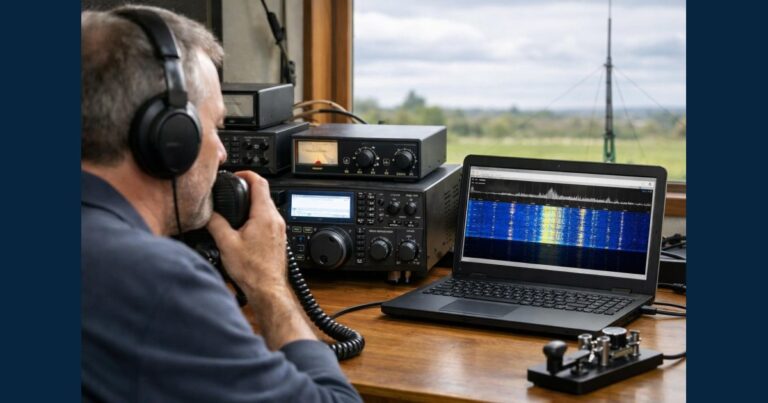
When people hear the words amateur radio operator, they may still imagine someone sitting in front of an old radio, wearing headphones and talking to somebody on the other side of the world.
Today, amateur radio is much more than that.
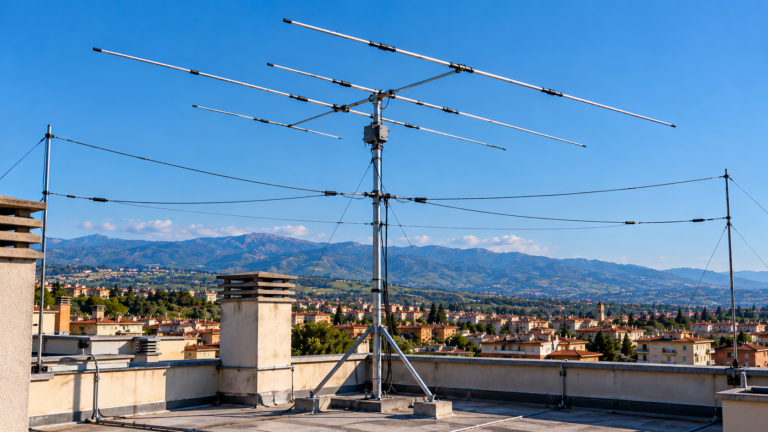
Behind a modern amateur radio station there may be electronics, antennas, computers, propagation The way radio waves travel through the air. studies, digital modes, satellites and technical experimentation.
But there is another important aspect: amateur radio can provide communication that does not necessarily depend on conventional telephone networks or the Internet.
That is one of the reasons why amateur radio is still relevant today.
When the Internet stops working, radio can still communicate.
Who is an amateur radio operator?
An amateur radio operator is a licensed person authorised to use specific radio frequencies for non-commercial communication, technical experimentation and education.
Every operator is assigned a unique call sign Every radio amateur’s personal “number plate”, like IZ6CLV..
For example:
IZ6CLV
That call sign becomes the operator’s identity on the air.
On the other side of the signal there may be another operator a few kilometres away or someone in Japan, Brazil, the United States or Australia.
Under the right propagation The way radio waves travel through the air. conditions, a radio and an antenna may be all that is needed to establish contact.
Communication without the Internet
Modern smartphones make communication appear almost effortless.
However, behind a simple message or phone call there are many infrastructures:
- cellular towers;
- fibre-optic networks;
- servers;
- electrical power;
- Internet connections;
- network providers.
If part of that infrastructure fails, communication may become difficult.
Radio works differently.
Two stations can communicate directly:
Radio → antenna → radio waves → antenna → radio.
No Wi-Fi network is required.
No Internet provider is required.
No central server is necessarily required.
What happens during an emergency?
Imagine a severe storm causing a widespread power failure.
Several cellular towers stop operating.
Internet connections disappear.
A landslide blocks a mountain road and several homes become isolated.
The smartphones still work perfectly, but the display says:
No service.
A charged battery is of little use if there is no network available.
An amateur radio station, however, may continue operating from a battery, portable generator or solar panel.
If another radio station can be reached, communication remains possible.
A simple message can matter
An operator located in the isolated area could transmit:
“The road is blocked by a landslide. Several people are isolated and one person needs medical assistance. There is no cellular service.”
Another operator located outside the affected area could receive the message and pass the information through the appropriate channels.
This simple example explains why an independent radio network can provide a valuable additional communication resource.
More than voice: digital data over radio
Modern amateur radio is not limited to voice communication.
Radios can be connected to computers and used to transmit digital information.
Depending on the system being used, operators can exchange:
- text messages;
- geographical coordinates;
- weather information;
- telemetry;
- small files;
- operational information.
This can be done even when normal local Internet access is unavailable.
APRS: location and information by radio
One well-known amateur radio system is APRS A system for sending your position and short messages by radio. — Automatic Packet Reporting System.
APRS can automatically transmit GPS positions together with other information.
Examples include:
- vehicle positions;
- team locations;
- weather-station data;
- short messages;
- telemetry.
This can be particularly useful during field operations because the positions of stations can be shared through radio links.
E-mail without Wi-Fi?
It may sound unusual, but systems also exist that allow e-mail messages to be transferred using radio.
One of the best-known amateur radio systems is Winlink A system for sending email by radio..
The idea is relatively simple.
A computer prepares the message.
The radio transmits it.
A remote station receives it.
If that station has access to other networks, the message can then continue toward its destination.
Depending on the configuration, radio stations can also exchange messages without relying on local Internet access.
Packet Radio: networking before the modern Internet
Long before Internet access became common in homes, amateur radio operators were already transferring digital information over radio.
This system became known as Packet Radio.
Information was divided into small packets and transmitted between radio stations.
Many networking concepts that are familiar today were already being explored by amateur radio operators decades ago.
The technology has changed, but the basic idea remains fascinating:
connecting computers through radio waves.
Radio Mesh networks
Another interesting area involves Mesh networks.
Imagine several radio nodes distributed throughout an area.
Station A cannot reach station C directly, but both can communicate with station B.
Station B can act as an intermediate node:
A → B → C
By adding more nodes, it becomes possible to build a distributed network.
Such networks can potentially carry:
- messages;
- data;
- VoIP communications;
- telemetry;
- local web pages;
- camera images.
A key feature is that the local network can continue operating even without a conventional Internet connection.
Amateur radio during emergencies
Amateur radio does not replace professional communication systems operated by emergency services.
It can, however, provide an additional communications layer when ordinary infrastructure is damaged or temporarily unavailable.
Situations may include:
- earthquakes;
- floods;
- landslides;
- wildfires;
- major blackouts;
- severe weather;
- telephone network failures;
- isolated communities.
Under these conditions, a properly organised radio station can help maintain communication between otherwise disconnected locations.
An independent station
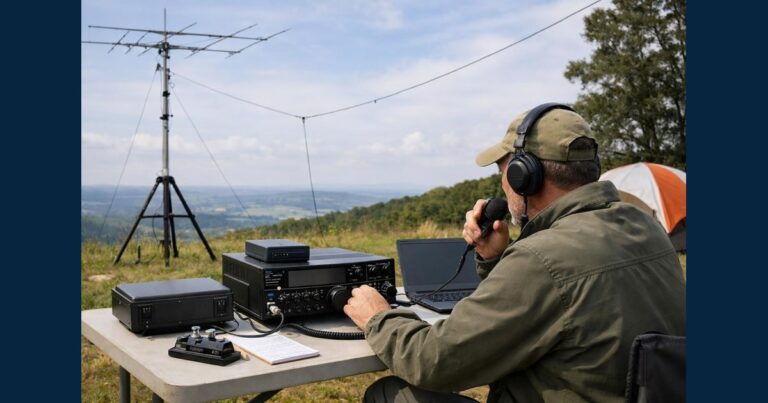
An amateur radio station can be made almost completely self-contained.
A portable setup might include:
Radio equipment
HF Shortwave, between 3 and 30 MHz, which can reach the other side of the world., VHF The frequencies between 30 and 300 MHz, home to FM radio and aircraft, for example. or UHF The frequencies between 300 and 3000 MHz. depending on the required communication distance.
Battery
To operate during a power failure.
Solar panel
To recharge batteries during extended operations.
Laptop computer
For digital communications and message handling.
Antenna
Even relatively simple portable antennas can provide useful communication.
GPS receiver The device that “listens” to radio signals.
To determine and transmit location information.
Such a station can be installed temporarily in a vehicle or carried into an isolated area.
Experience matters more than expensive equipment
Owning an expensive radio does not automatically make someone prepared for an emergency.
Experience matters much more.
Operators need to know:
- which bands to use;
- how to install an antenna quickly;
- how to provide emergency power;
- how to listen before transmitting;
- how to pass information clearly;
- how to operate digital systems;
- how to cooperate with other stations.
This is why everyday amateur radio activity is valuable.
DXing, contesting, building antennas, experimenting with digital modes and solving technical problems all develop useful practical experience.
A hobby that also builds real skills
Amateur radio begins with passion.
There is a unique satisfaction in hearing a distant station, improving an antenna and finally completing a difficult contact.
But along the way, operators also develop practical knowledge in:
- electronics;
- telecommunications;
- computing;
- radio propagation The way radio waves travel through the air.;
- antennas;
- independent power systems;
- communication procedures.
That combination of curiosity, experimentation and practical experience is what makes amateur radio unique.
Radio and the Internet are not competitors
The Internet is vastly superior when it comes to speed, data capacity and convenience.
There is no reason to pretend otherwise.
Radio offers something different.
It can be independent.
When everything is working normally, smartphones, fibre and Wi-Fi will usually be the easiest choice.
But when infrastructure becomes unavailable, an alternative communication system may become extremely valuable.
The value of radio is not measured when every network is working. Its importance becomes clear when the other networks are no longer available.