Does the Perfect Antenna Exist?
In the world of amateur radio, DXing on the HF Shortwave, between 3 and 30 MHz, which can reach the other side of the world. (High frequency The “channel” a station transmits on.) bands represents the ultimate challenge. Making contacts with stations thousands of kilometres away is not simply a matter of power (watts), but above all of the efficiency of the radiating system.
But does the perfect antenna for DX A contact with a very distant station. really exist? The short answer is no. However, there are configurations that maximise the chances of success by relying on precise physical principles. In this technical guide, we will analyse the key factors for optimising your station. Radio Meteo
1. The Secret of DX: Radiation Angle (Take-off Angle)
For DX A contact with a very distant station., the most critical parameter is not absolute gain How much an antenna or amplifier “boosts” the signal., but the take-off angle of the radiation lobe. To allow the signal to be refracted by the ionosphere A high layer of the atmosphere that makes shortwave signals “bounce”. and cover intercontinental distances, we need a low angle, typically between 5° and 15°.
- Vertical Antennas: Excellent for low take-off angles, but often subject to higher background noise (QRN Natural noise, for example from lightning.).
- Horizontal Antennas: Require significant height above ground in order to push the radiation lobe towards the horizon.
Golden rule: A horizontal dipole A simple antenna made of two equal arms, one on each side. should be installed at a height of at least λ/2 (half a wavelength) above ground before it begins to become truly competitive for DX. Radio Meteo
2. Directivity and Gain: Yagi vs. Cubical Quad
If space and budget allow, a directional antenna is the preferred choice.
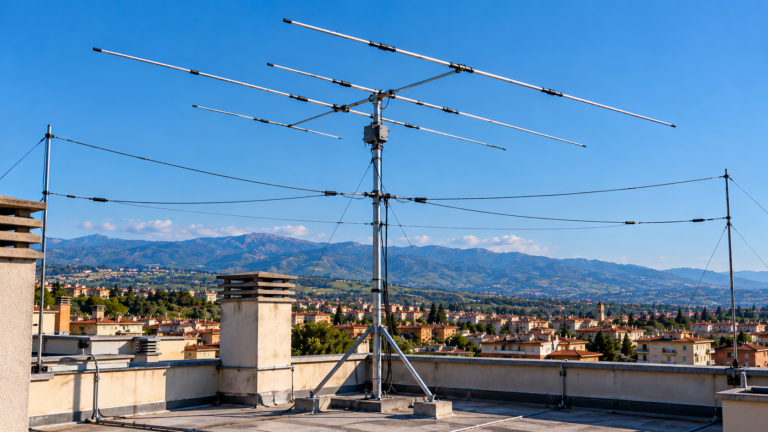
Yagi-Uda Antennas
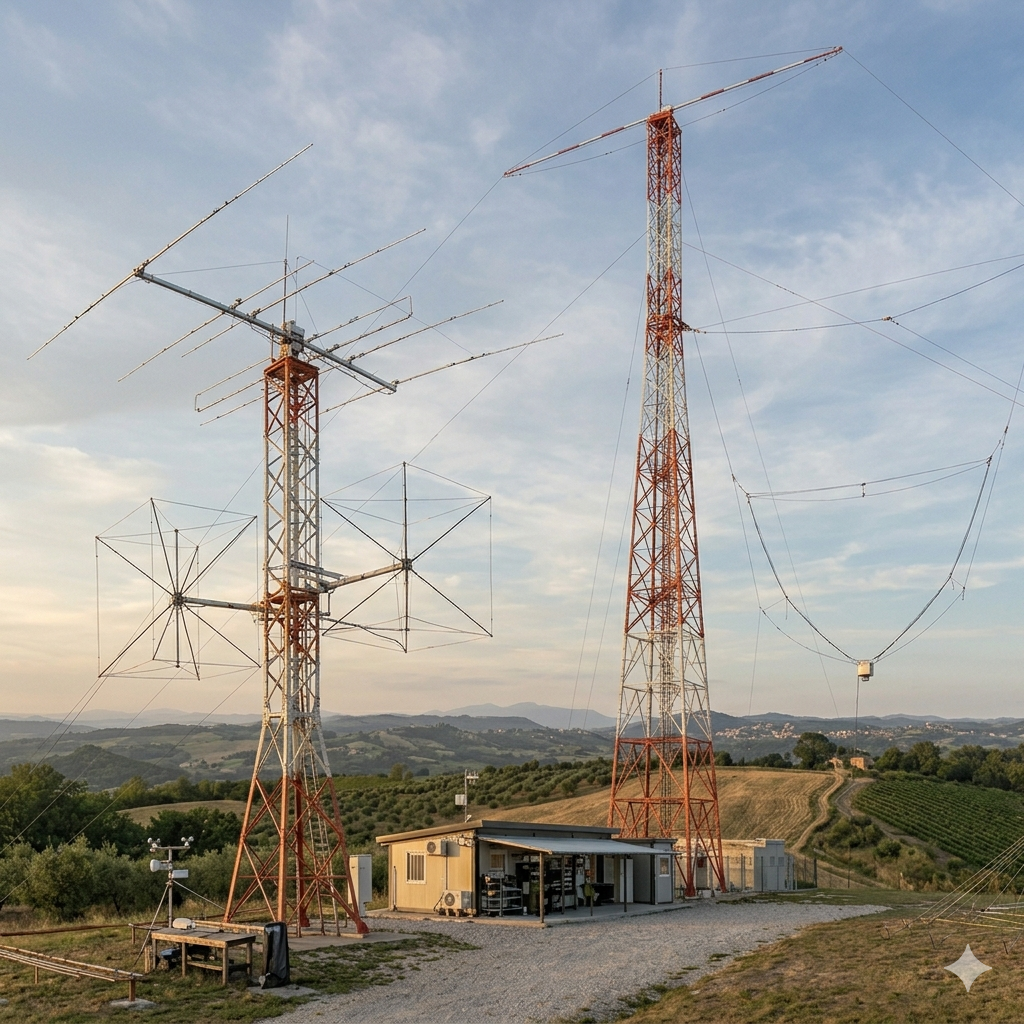
The Yagi A “fishbone” antenna that hears best in one direction. is the industry standard. It concentrates energy in a specific direction while reducing interference coming from other directions.
- Advantages: Robust construction, high directivity.
- Disadvantages: Requires an antenna rotator and a suitable tower.
Cubical Quad
Many dedicated DXers prefer the Quad. With the same number of elements, a Quad often provides slightly higher gain How much an antenna or amplifier “boosts” the signal. and wider bandwidth How much room a signal takes up across the frequencies. than a Yagi, thanks to its closed-loop structure, which also tends to make it quieter in terms of static noise. Radio Meteo
3. Solutions for Limited Space: Verticals and Delta Loops
Not everyone can install a 20-metre tower. Here are some of the most efficient technical alternatives:
- Vertical with an elevated ground plane A vertical antenna with a few sloping arms at its base.: A 1/4-wave vertical with a good radial system can be an exceptional DX A contact with a very distant station. antenna for 40 and 80 metres.
- Delta Loop: Configured with the apex at the top and fed one quarter-wavelength from a lower corner, the Delta Loop provides vertical polarisation with very low take-off angles, making it ideal for DX. Radio Meteo
4. The Importance of the Feed System
The perfect antenna is useless if power is lost in the cable or reflected because of an impedance A measure of how well the antenna, cable and radio pass the signal to each other. mismatch.
- Transmission Lines: For long cable runs, choose low-loss coaxial cables such as RG-213 or modern Ultraflex cables.
- Baluns and Ununs: Essential for balancing currents and preventing RF from returning into the shack. A high-quality 1:1 balun A small adapter fitted between the antenna and the cable. on a dipole A simple antenna made of two equal arms, one on each side. helps prevent distortion of the radiation pattern.
- SWR A number that tells you whether the antenna and radio “get along”: the closer to 1, the better.: Although modern antenna tuners allow transmission across a wide frequency The “channel” a station transmits on. range, the antenna should be as naturally resonant as possible in order to maintain maximum efficiency. Radio Meteo
5. Polarisation: Horizontal or Vertical?
For ionospheric propagation The way radio waves travel through the air. (skywave), the original polarisation of the signal is rotated unpredictably during propagation. However:
- Vertical polarisation is generally preferred for DX A contact with a very distant station. over ground with good conductivity, especially near the sea.
- Horizontal polarisation benefits from ground gain How much an antenna or amplifier “boosts” the signal. when the antenna is installed sufficiently high, and is generally less sensitive to local electrical interference (man-made noise). Radio Meteo
Conclusions: Which One Should You Choose?
If we had to define the “ultimate” DX A contact with a very distant station. antenna, it would probably be a multi-element Yagi A “fishbone” antenna that hears best in one direction. installed approximately 20 metres above ground.
If space is your main limitation, a vertical antenna with an excellent radial system or a single-band Delta Loop can still provide outstanding results in major international pile-ups.
Remember:
The best amplifier is always a good antenna. Radio Meteo