Imagine turning on your radio on a Saturday morning and finding the bands completely transformed. Thousands of stations calling at the same time, signals arriving from every corner of the planet, call signs coming one after another at a speed that at first seems impossible to follow. Welcome to the world of amateur radio contests.
If you are a beginner amateur radio operator, your first reaction might be to switch everything off and wait for it to end. That would be a huge mistake. Contests are one of the most effective training grounds for improving your operating skills, learning propagation The way radio waves travel through the air., discovering the limits of your station and — above all — having fun in a way that few other amateur radio activities can match.
In this guide I will explain everything you need to know to take part in your first amateur radio contest A competition between radio amateurs to make as many contacts as possible in a set time.: how contests work, what you need, which software to use, operating strategies and the most important contests you can enter today.
What Is an Amateur Radio Contest?
An amateur radio contest A competition between radio amateurs to make as many contacts as possible in a set time. — also called an HF Shortwave, between 3 and 30 MHz, which can reach the other side of the world. competition — is a time-limited event in which amateur radio operators from all over the world contact one another, trying to make as many QSOs (radio contacts) as possible within the specified period.
The duration varies: some contests last 24 hours, others 48 hours, while some last only 60 minutes. The goal is not simply to make as many contacts as possible — multiplier systems are also used to reward geographical variety.
Each contest has its own rules, which establish:
- The permitted operating bands (80m, 40m, 20m, 15m, 10m…)
- The allowed modes (SSB A voice mode widely used by radio amateurs on shortwave., CW Morse code sent by radio., FT8 A digital mode: the computer sends and receives short messages even with very weak signals., mixed)
- The exchange — the information that the two operators must exchange during each QSO A radio contact between two stations.
Contest Vocabulary — Terms You Need to Know
Before operating during a contest A competition between radio amateurs to make as many contacts as possible in a set time., it is essential to understand the specific terminology. These are the most important terms:
QSO A radio contact between two stations. — A completed radio contact between two stations.
- Exchange — The mandatory information exchanged during each QSO. Depending on the contest, this may be RST + serial number, RST + CQ zone, or RST + province.
- RST — Signal report: Readability, Strength, Tone (for CW Morse code sent by radio.). In SSB A voice mode widely used by radio amateurs on shortwave. voice operation, RS is used, typically “59”, meaning a perfect signal.
- Multipliers — Geographical entities such as countries, zones, provinces or regions that multiply the base score. The more multipliers you work, the higher the final score.
- Running — An operating strategy where you occupy a frequency The “channel” a station transmits on. and call CQ while waiting for other stations to answer. It requires a good signal.
- Search & Pounce (S&P) — An alternative strategy where you scan the band A group of nearby frequencies used for the same purpose, like a lane on a motorway. looking for stations calling CQ and answer them. Ideal for stations with limited power or antennas.
- Pileup — A situation where dozens or hundreds of stations call the same rare or DX A contact with a very distant station. station at the same time.
- Dupe — A duplicate contact with a station already worked. Dupes do not score points and should be avoided.
- Log — The electronic record of all QSOs made during the contest.
- Cabrillo — The universal standard format used to submit contest logs. Virtually all modern contest software generates it automatically.
- SO1R / SO2R — Single Operator 1 Radio / Single Operator 2 Radio. SO2R is an advanced technique that allows you to transmit on one radio while listening on another simultaneously.
Entry Categories
Every contest A competition between radio amateurs to make as many contacts as possible in a set time. offers different categories so operators can compete fairly against stations with similar setups. The main categories are:
Single Operator (SO) — One operator manages everything: transmission, reception and logging. This is the most common category for beginners.
Multi Operator Single transmitter The device that sends the radio signal into the air. (M/S) — A team of operators takes turns operating, but only one radio transmits at a time.
Multi Operator Multi Transmitter (M/M) — Multiple operators and multiple radios operating simultaneously. This is the category used by large professional contest stations.
QRP Transmitting with very little power, usually 5 watts or less. — Maximum power of 5 watts. A fascinating category that rewards operating skill and antenna quality.
Low Power — Usually up to 100 watts. The ideal category for most home stations.
High Power — Maximum power permitted by the licence, typically 1500 W in the USA and 500 W in Italy.
Assisted / Non-Assisted — Assisted allows the use of the DX A contact with a very distant station. Cluster to locate stations to work. Non-Assisted does not.
Contest Software — What to Use
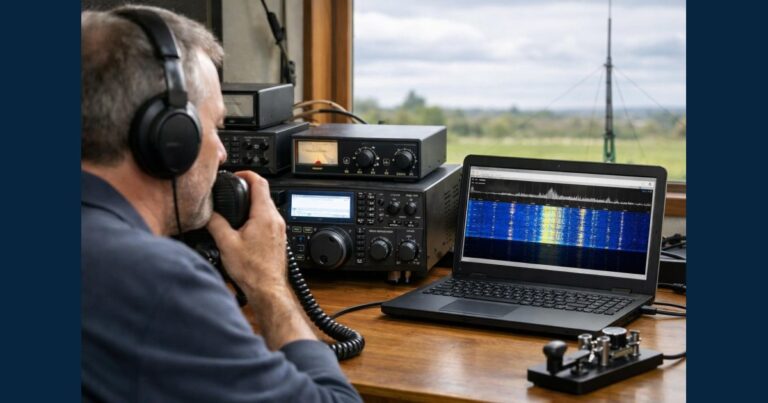
Taking part in a contest without good logging software is practically impossible. The software manages the log in real time, checks for duplicates, calculates the score and generates the Cabrillo file for submission.
N1MM+ Logger
The most widely used software in the world for HF Shortwave, between 3 and 30 MHz, which can reach the other side of the world. contests. Free, extremely powerful and constantly updated by the community. It supports hundreds of different contests and integrates with virtually any transceiver A radio that can both receive and transmit. via CAT The link that lets a computer control the radio..
Log4OM
Excellent Italian software with an integrated contest module. Ideal if you already use it for everyday logging.
Win-Test
Professional software used by many of the best European contest stations. Paid, but with a free trial period.
🔗 Win-Test
TR4W
A free alternative to N1MM, widely used in Eastern Europe.
🔗 TR4W
How a Contest QSO Works — Step by Step
An SSB A voice mode widely used by radio amateurs on shortwave. contest A competition between radio amateurs to make as many contacts as possible in a set time. QSO A radio contact between two stations. usually lasts around 10–15 seconds.
Example in Running mode (you call CQ):
IZ6CLV: "CQ Contest, CQ Contest, India Zulu Six Charlie Lima Victor"
DK5ABC: "DK5ABC"
IZ6CLV: "DK5ABC, 59 001" (signal report + serial number)
DK5ABC: "59 087, 73"
IZ6CLV: "73, QSL"
In just a few seconds, all required information has been exchanged. The software automatically logs the QSO, updates the score and indicates whether it is a new multiplier.
Example in Search & Pounce mode (you answer):
G3XYZ: "CQ Contest G3XYZ"
IZ6CLV: "IZ6CLV"
G3XYZ: "IZ6CLV, 59 234"
IZ6CLV: "59 001, 73"
The Most Important Contests in the World
CQ World Wide DX Contest (CQ WW)
The largest amateur radio contest in the world. It is held in two editions: SSB (last weekend of October) and CW (last weekend of November). More than 35,000 stations from over 200 countries take part every year. The exchange is RST + CQ Zone.
ARRL DX Contest
Organised by the American Radio Relay League, it is one of the most prestigious contests for contacts between the USA/Canada and the rest of the world. It is held in SSB (March) and CW (February).
IARU HF World Championship
A contest organised by the International Amateur Radio Union. It is held in July and rewards contacts with IARU member-society stations.
ARI International DX Contest
The Italian national contest organised by the Associazione Radioamatori Italiani. It is held in May and is an excellent opportunity for foreign stations to work Italy and for Italian operators to work the world.
WAE DX Contest
Worked All Europe is a European contest with a unique feature: the QTC system, which adds an interesting strategic dimension.
YOTA Contest
The Youngsters On The Air Contest is dedicated to young operators and stations that support them. Perfect for anyone approaching contesting for the first time.
Italian Contests Not to Miss
In addition to the ARI DX Contest, there are many popular Italian national contests:
ARI Sections Contest — Organised by local ARI sections, with the exchange of Italian provinces.
ARI Cup — CW contest dedicated to Italian operators.
Italian VHF/UHF Contests — For those who prefer the higher bands, there are contests dedicated to 144 MHz and 432 MHz using Maidenhead locator exchanges.
Operating Strategy for Beginners
Before the contest
Study the rules — Every contest has different rules. Read them carefully, especially the section about the exchange.
- Configure the software — Enter your call sign, category and power level. Test CAT integration with your transceiver.
- Prepare the station — Check antenna SWR, test the microphone and adjust the audio. During the contest there is no time for technical problems.
- Check propagation — Use DXMaps or PSKReporter to understand which bands are open.
- Choose the right category — For your first contest choose Single Operator, Low Power, Assisted. This allows you to use the DX Cluster to find stations.
During the contest
Start with Search & Pounce — Scan the band slowly and answer stations calling CQ. It is the easiest way to build QSOs without the pressure of running.
Keep the volume moderate — After hours of contesting, your ears become tired. Use headphones and keep the volume comfortable.
Change bands often — Do not stay on a single band. Propagation changes continuously. 40 metres at night, 20 and 15 metres during the day, 10 metres when the solar cycle allows it.
Keep track of missing multipliers — The software shows which multipliers you have already worked. Actively look for those you are missing — they are extremely valuable.
Do not give up on difficult QSOs — If a station is having trouble hearing you, try again. Lost points cannot be recovered.
After the contest
Check the log — Look for incorrect call signs, missing exchanges or wrong data.
Generate the Cabrillo file — Your logging software will do this automatically.
Submit the log — Even if you made only a few QSOs, always submit your log. It helps validate other participants’ logs and may be used as a check log.
Analyse the results — After a few weeks the results are published online. Study the rankings to understand what you can improve.
Propagation in Contests — How to Use It
Ionospheric propagation is one of the most important factors affecting success in an HF contest. Understanding how it works is essential.
10-metre band (28 MHz) — When open, it is spectacular. Very strong worldwide signals can be worked with small antennas. However, it depends heavily on the solar cycle and can be almost unusable during solar minima.
15-metre band (21 MHz) — Excellent during the day, especially around midday. Very good for intercontinental DX.
20-metre band (14 MHz) — The most reliable band. It works almost all the time, day and night, and is the heart of most HF contests.
40-metre band (7 MHz) — The classic night-time band. At night it opens to intercontinental distances; during the day it works well for Europe.
80-metre band (3.5 MHz) — Heavy European traffic, particularly at night. Noisy but effective for accumulating European QSOs.
To monitor propagation in real time use:
🔗 DXMaps — Real-time propagation
🔗 Space Weather — Solar indices
🔗 VOACAP — Propagation forecasts
Minimum Equipment for Contesting
You do not need a €100,000 station to enter a contest. The minimum setup is:
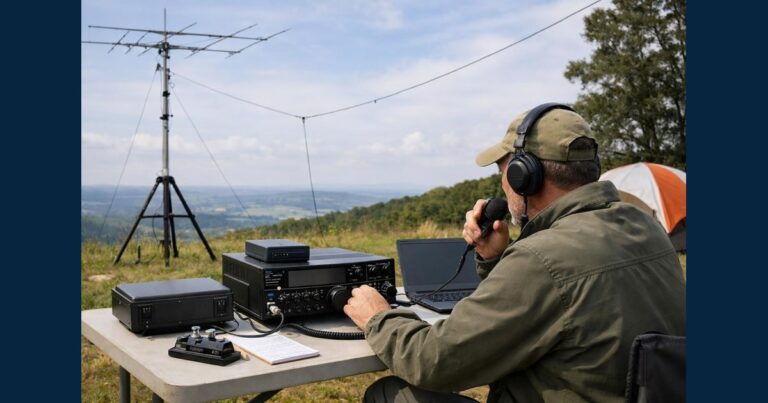
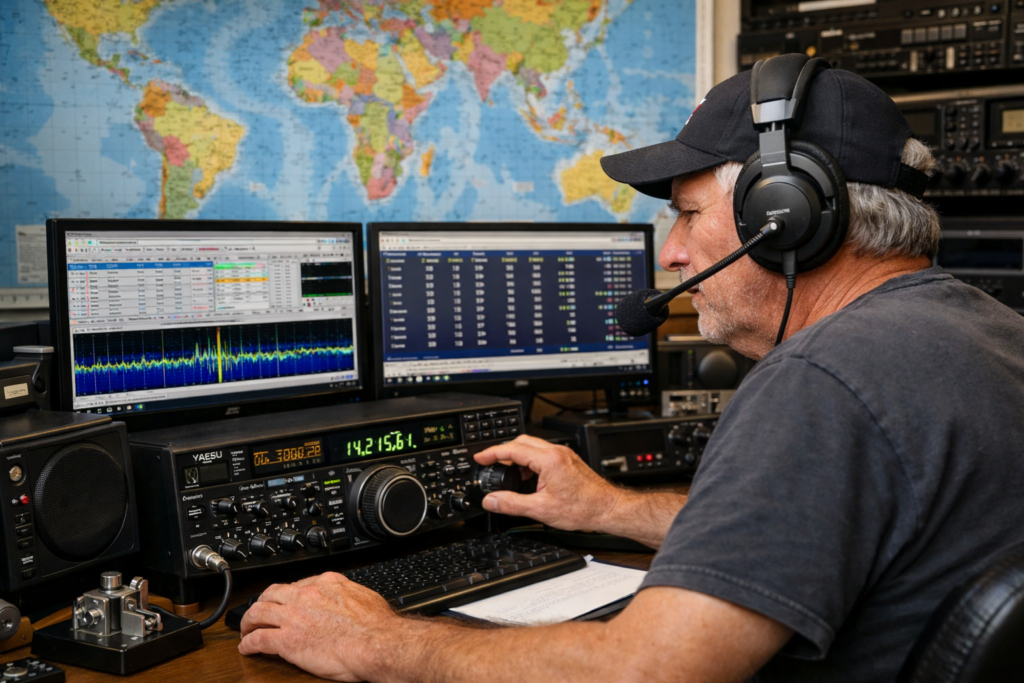
HF Transceiver — Any modern radio will work. A YAESU FT-DX10, ICOM IC-7300 or Kenwood TS-590 are excellent choices.
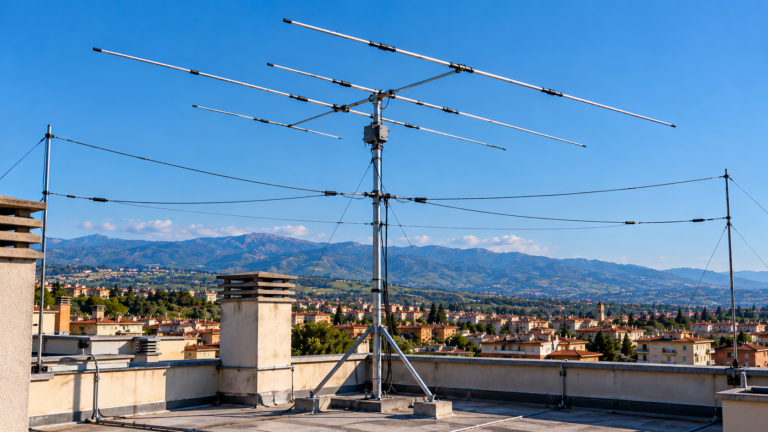
Antenna — A simple dipole works. A multiband vertical or directional antenna is even better. The antenna makes more difference than the radio.
CAT Interface — A USB-CAT cable to connect the radio to the PC and allow the software to control frequency and mode automatically.
Headphones — Essential. After 12 hours of contesting without headphones, your ears will not thank you.
PC with software — A normal laptop running N1MM+ or Log4OM is more than enough.
Contesting and Operating Ethics
A contest is a competition, but above all it is still a community. Some unwritten rules are fundamental:
Do not transmit on someone else’s frequency — If a frequency is occupied, find another one.
Be clear and precise — Pronounce your call sign slowly and clearly, especially in SSB.
Do not act as frequency police — If someone makes a mistake, it is not your job to correct them on the air.
Respect exclusive band segments — Some portions of the bands are reserved for beacons or other services. Do not transmit there.
Always submit your log — Even if you made only 10 QSOs. It is a gesture of respect towards the organisers and the other participants.
Useful Resources for Contesters
🔗 Contest Calendar — Complete contest calendar
🔗 3830 Scores — Contest scores and reports
🔗 DX Summit — Online DX Cluster
🔗 QRZ.com — Call sign database
🔗 ARRL Contest Rules
🔗 REF Contest
🔗 N1MM+ Documentation
Conclusion — Your First Contest Is Waiting for You
Taking part in your first amateur radio contest is an experience that will change the way you see radio. The first few hours may feel confusing, hectic and perhaps a little frustrating. Then something clicks. You begin to understand the rhythm, separate signals from the noise and optimise your QSOs. And when you see your score rising, QSO after QSO, country after country, you will wonder why you waited so long.
It does not matter whether your station is simple, whether your antenna is just a wire stretched between two trees, or whether you are operating with only 5 watts QRP. Contests are for everyone. Radio does not lie — it rewards those who study, prepare and improve.
IZ6CLV will be waiting for you on the bands. 73 and good contesting!