Update, 20 October 2026. The first version of this article cited Article 91 of the Italian Electronic Communications Code using the numbering in force before Legislative Decree 207/2021. Thanks to the readers who pointed this out. The text has been revised: the correct reference for amateur radio antennas is Article 209, and verified rulings of the Italian Supreme Court (Corte di Cassazione) have been added.
Italy only. This article describes Italian law and Italian case law. It does not apply in other countries: if you live outside Italy, check your national rules and your amateur radio association.
📌 IN BRIEF (ITALY ONLY)
- In Italy, you can put a ham radio antenna where you live. The law says so: Article 209.
- The owner cannot say no. This also applies if you rent.
- First use your own space, like your balcony, or a shared space, like the roof.
- You can use someone else’s private terrace only if there is no other place. And you must prove it.
- Do not cause damage and do not take space away from others.
- Always tell the property manager and check your town’s rules.
In Italy, installing an amateur radio antenna in a condominium is protected by law, within precise limits. What matters is the location chosen, the alternatives available and respect for the rights of the other owners. Below is the legal framework and case law, using verified sources only.

- Balcony: it is your own space, but how it sticks out and is fixed matters
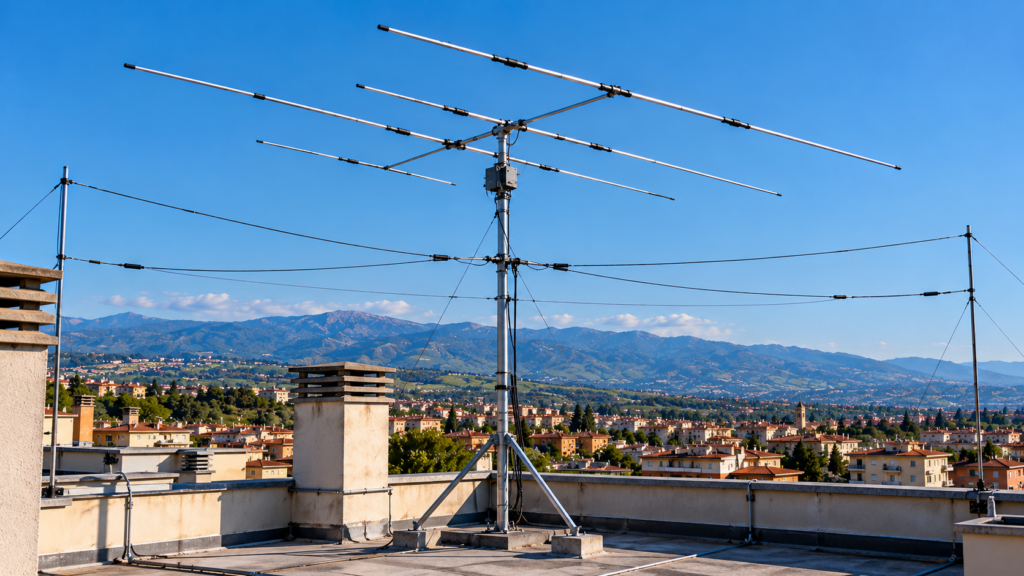
- Roof: it belongs to everyone, you need agreements on access and position
Teaching illustration created by RadioMeteo.
What does the right to install an antenna provide
The key provision is Article 209 of the Italian Electronic Communications Code (Legislative Decree 259/2003). Paragraph 1 states that property owners cannot oppose the installation, on their property, of antennas belonging to the occupants of the building and intended for amateur radio services. The law refers to “occupants”, so the right also applies to tenants.
Paragraph 2 sets the limits: antennas, supports, cables and accessories must not prevent the property from being used freely for its intended purpose, and must not cause damage to the property or to third parties.
A note on numbering. Legislative Decree 207/2021 replaced Articles 1 to 98 of the Code: the provisions on legal restrictions on property and on easements, formerly in Articles 91 and 92, are now in Articles 52 and 53, while the current Article 91 deals with a different matter. Article 209 was not amended; its paragraph 3 still refers to Articles 91 and 92 under the original numbering.
Articles 52 and 53 concern the electronic communications network operators referred to in Article 51: they are not the basis of the radio amateur’s right. What matters for us are paragraphs 1 and 2 of Article 209. Paragraph 5 of the same article, which requires consent and compensation for antennas “for private use”, does not apply to radio amateurs: the Italian Supreme Court, in judgment no. 31101/2023, ruled out that compensation can be demanded from them. It remains open how, after the renumbering, the reference in paragraph 3 to former Articles 91 and 92 should be read.
The key legal reference is:
D.Lgs. 259/2003, art. 209, paragraphs 1 and 2 (Italy)The right to install an antenna exists, but it must be used sensibly: your own or shared spaces first, without damage and without preventing others from using them.
What the Italian Supreme Court says
The most recent and specific ruling is judgment no. 31101/2023 of the Italian Supreme Court (Corte di Cassazione, Second Civil Section), published on 8 November 2023, which concerned a radio amateur’s antenna.
The Court links the right to install an antenna to freedom of expression, protected by Article 21 of the Italian Constitution. It also makes clear that the right is not unlimited: it must be balanced against property rights, which are also constitutionally protected.
This leads to a necessity test. Installing an antenna on someone else’s private property, such as another owner’s roof terrace, is allowed only if the radio amateur cannot use their own or shared spaces. Convenience alone is not enough, and the burden of proving that there is no alternative lies with the person installing the antenna, including through a technical expert report. The same principle had already been stated in Cass. civ., Section II, no. 9427 of 21 April 2009.
According to the 2023 judgment, once this is proven, the installation requires neither the owner’s prior written consent nor the payment of compensation.
Ham radio antenna on a balcony: what should you clarify
A balcony is normally a space you own or use exclusively, and under the necessity test it is the first place to consider. However, a balcony installation may also involve the façade, the walls or the cable route, which can be shared parts of the building.
Before proceeding, define exactly where the antenna will go, how it will be mounted and where the cables will run, checking compliance with the limits in Article 209, paragraph 2.
If the balcony is not suitable, for example because physical obstacles reduce the antenna’s efficiency, document this with a technical assessment. It will be the decisive element if you need to ask to use the roof or another space.
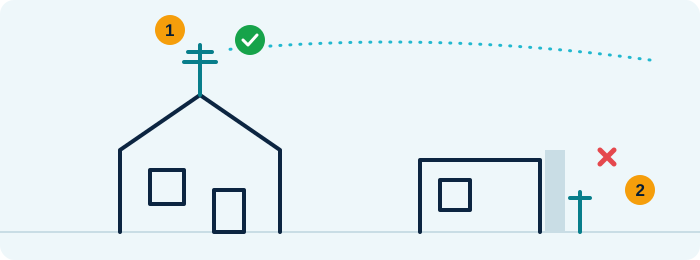
- Antenna on the roof, away from obstacles: the signal arrives clean
- Low antenna behind a wall: the signal gets blocked
Teaching illustration created by RadioMeteo.
💡 OM/SWL TIP: Tell the property manager in writing where and how you plan to install the antenna, and keep a copy. If the balcony is not suitable, explain the technical reasons too.
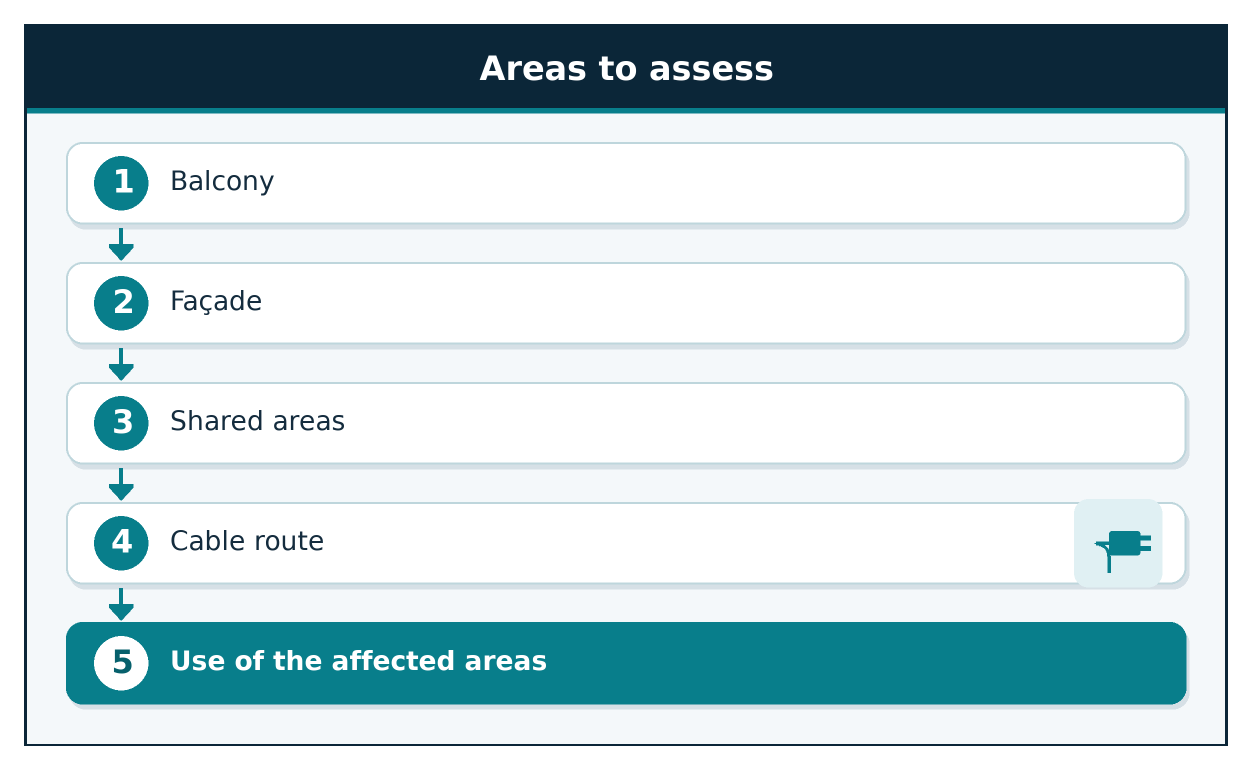
The diagram below shows the elements to distinguish when assessing a balcony. It is illustrative: it does not depict a specific building or provide measurements or mounting instructions.
Are the roof and access to it the same issue?
Under Article 1117 of the Italian Civil Code, the roof is one of the shared parts of the building. Anyone claiming exclusive ownership must prove it: the presumption of shared ownership can only be overcome by evidence to the contrary (Cass. civ., Section II, no. 17928 of 23 August 2007).
Each owner may use the shared parts, provided they do not change their purpose and do not prevent the others from using them equally (Article 1102 of the Italian Civil Code). On the roof, the installation must therefore be proportionate, not bulky, and must not block access for others.
The right to install and the ability to access the roof remain separate questions, including for safety reasons. ARI, the Italian amateur radio association, covers this topic in its article on access to a condominium roof (in Italian).
On the building-permit side, the Regional Administrative Court of Liguria (TAR Liguria, Section I, no. 540 of 20 June 2017) held that an amateur radio antenna on a condominium roof does not require a building permit, unless it involves works that significantly affect the rights of the other owners. Local municipal rules, landscape restrictions or historic-centre requirements still need to be checked.
What should you check with the property manager and condominium
Keep the discussion focused on specifics: balcony or roof, the size of the installation, the cable route and the mounting method. Ask to review the condominium rules.
The right to install an antenna is recognised by Italian law, but it must be exercised with respect for the other owners, safety and the building. In case of a serious dispute, consult a lawyer specialising in Italian civil law.
The table summarises the provisions and rulings cited.
| Reference | What it covers | Practical note |
|---|---|---|
| Art. 209, para. 1, D.Lgs. 259/2003 | Owners cannot oppose the occupants’ antennas | Core provision for amateur radio services |
| Art. 209, para. 2, D.Lgs. 259/2003 | Limits for antennas, supports and cables | No obstruction of the property’s use and no damage |
| Arts. 1102 and 1117, Italian Civil Code | Use of shared parts; the roof as a shared part | Use allowed without preventing equal use by others |
| Cass. civ., Section II, no. 31101/2023 | Amateur radio antenna on someone else’s private property | Allowed only if there is no alternative, which must be proven |
| Cass. civ., Section II, no. 9427/2009 | Limits of the right to install an antenna | Own or shared spaces come first |
| Cass. civ., Section II, no. 17928/2007 | Presumption of shared ownership | Anyone claiming exclusive ownership must prove it |
| TAR Liguria, Section I, no. 540/2017 | Roof antenna and building permits | Normally not required, unless significant works are involved |
What should you clarify before installing
First identify the surface: balcony, façade or roof. Check whether a solution exists using your own or shared spaces, discuss it with the property manager, and check the condominium rules and municipal regulations. Finally, install everything properly and safely.
For more background, read the text of Article 209 on Normattiva, the ARI article on the right to install an antenna in a condominium and the ARI commentary on the 2023 Supreme Court judgment (all in Italian).
Verified sources
- Legislative Decree no. 259 of 1 August 2003 (Italian Electronic Communications Code), Art. 209, paragraphs 1 and 2
- Legislative Decree no. 207 of 8 November 2021 (replacement of Articles 1 to 98 of the Code)
- Italian Constitution, Art. 21
- Italian Civil Code, Arts. 1102 and 1117
- Italian Supreme Court (Corte di Cassazione), Second Civil Section, no. 31101/2023, published 8 November 2023
- Italian Supreme Court (Corte di Cassazione), Second Civil Section, no. 9427 of 21 April 2009
- Italian Supreme Court (Corte di Cassazione), Second Civil Section, no. 17928 of 23 August 2007
- Regional Administrative Court of Liguria (TAR Liguria), Section I, no. 540 of 20 June 2017
The author is not a lawyer. This article is for general information about Italian law only and is not legal advice. For a specific case, consult a lawyer specialising in Italian civil law.
This article was written with the collaboration of IW9CTJ, whom we thank for his in-depth contributions.
73 de IZ6CLV