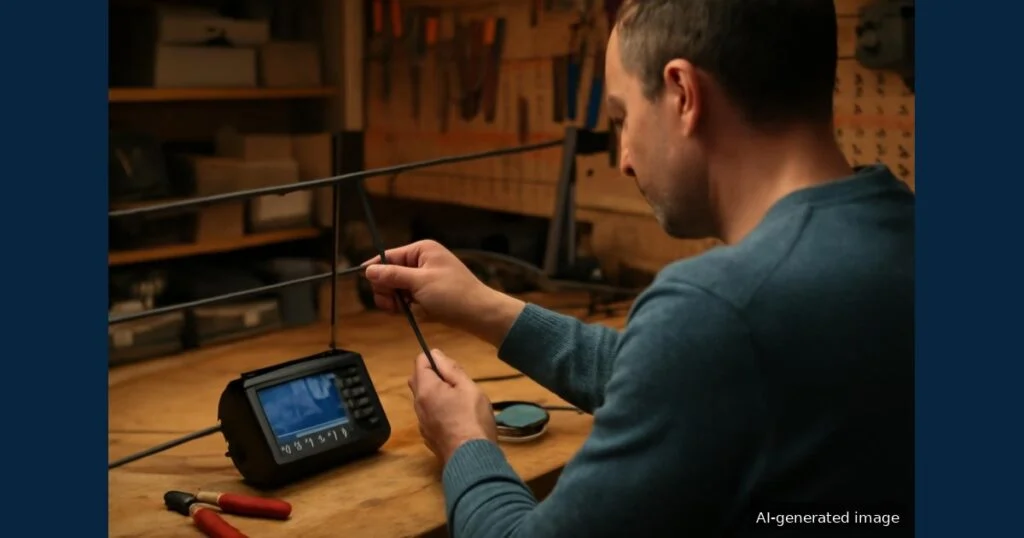
A dipole A simple antenna made of two equal arms, one on each side. (dipole: a simple antenna made of two equal arms, one on each side)—an antenna made of two equal arms, one on each side—can be off resonance because of the arm lengths or the way it is installed. To work out what needs adjusting, measure near the antenna and keep its position fixed: a reading taken at the station includes the feed line too.
If a dipole is off resonance, the measurement point affects the reading. Learn how to separate the antenna’s response from the feed line and decide whether to adjust the installation or the wire.
 Dipoletwo arms pick up radio waves
 Coaxial cableconnects antenna and station
 Analyzerchecks the antenna near the cable
 Transceivershows the whole system from the station
Off-resonance dipole: choose where to measure
The point where the cable connects to the two arms is called the feed point. I’d start there: connecting the instrument near this point lets you check the dipole A simple antenna made of two equal arms, one on each side. without including the full length of line running down to the radio.
An antenna analyzer sends out a test signal and measures the antenna’s response. If you connect it at the station, to the other end of the coaxial cable The round cable, like a TV cable, that carries the signal from the antenna to the radio. (that is, the round cable, like a TV cable, that carries the signal from the antenna to the radio)—a round, shielded cable that carries signals between the antenna and radio—you measure the dipole and the feed line together.
The feed line can lose energy. The amount of loss depends on the cable type and the frequency The “channel” a station transmits on. (that is, the “channel” a station transmits on), meaning how many times the signal moves back and forth each second, like a swing. SWR A number that tells you whether the antenna and radio “get along”: the closer to 1, the better. (standing wave ratio) indicates how well the antenna and radio are matched: a value closer to 1 is better. To interpret the reading, you need to know where you measured it.
If you can’t measure near the antenna, remember that the feed line affects the reading. Don’t cut the arms based only on the value measured at the station.
📌 Real case: A radio amateur asks where to connect an analyzer when tuning a dipole: near the antenna or at the end of the feed line. It’s a practical question about the measurement point; the discussion includes individual replies (discussion about where to measure a dipole).
Off-resonance dipole: check the lowest SWR before cutting
To find where the dipole A simple antenna made of two equal arms, one on each side. works best, I’d measure the SWR A number that tells you whether the antenna and radio “get along”: the closer to 1, the better. at several points across the band A group of nearby frequencies used for the same purpose, like a lane on a motorway. (that is, a group of nearby frequencies used for the same purpose, like a lane on a motorway), the range of frequencies you want to use. The lowest value shows where the reading is best for this measurement. One reading won’t tell you whether the minimum is above or below your target frequency The “channel” a station transmits on..
Compare the frequency of the minimum with the one you want to use. According to the procedure described by the ARRL, if the minimum is lower, the dipole is too long: shorten the arms a little at a time. If it is higher, the dipole is too short: lengthen the arms if you left enough wire to do so.
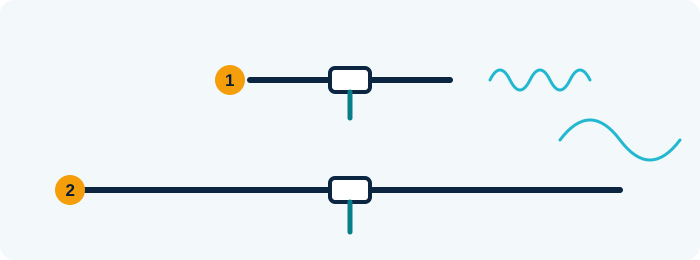
- Short arms: the antenna works best on higher frequencies
- Long arms: the antenna works best on lower frequencies
Teaching illustration created by RadioMeteo.
The position of the minimum relative to your target frequency helps you decide whether to shorten or lengthen the arms. After each change, measure at several points again and write down the results. Change one thing at a time so you can track the effect of each adjustment.
You can estimate the starting length with a formula, but the installed antenna still needs adjustment. For a single-band dipole, the ARRL guide gives an initial total length in feet of 468 divided by the frequency in megahertz (MHz Megahertz, millions of vibrations per second: the unit used to measure frequency.). One megahertz means one million cycles per second. I’d use the formula as a starting point and leave enough wire for adjustment.
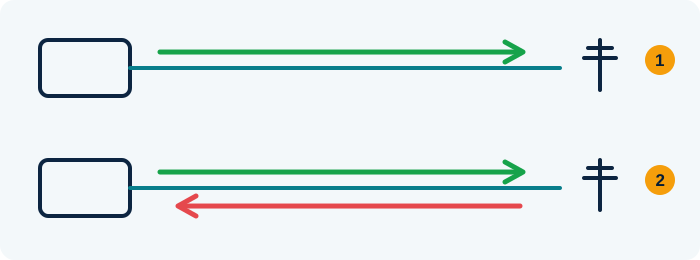
- Well-tuned antenna: almost all the energy goes out into the air
- Badly tuned antenna: part of the energy bounces back to the radio (high SWR)
An SWR meter measures how much comes back: the closer to 1:1, the better.
Teaching illustration created by RadioMeteo.
Check the installation before changing the length
A dipole A simple antenna made of two equal arms, one on each side. has two conductive arms, one on each side of the feed point. Its height and shape affect the measurement. When I adjust a dipole, I try to keep its position fixed: if you change the height or layout between tests, it becomes harder to tell what effect a cut has had.
The ARRL guide recommends installing the dipole as high and as straight as possible. If there isn’t enough room, you can bend the arms to fit the space. Keep the same shape while testing: moving or lowering a wire can change the measurement conditions.
Here’s an example: you’ve mounted the dipole between two points, and the lowest SWR A number that tells you whether the antenna and radio “get along”: the closer to 1, the better. reading is outside the frequency The “channel” a station transmits on. range you want. Before shortening the wire, check that the arms are in the intended position and that the analyzer is connected at the same point. If you change the installation and the length together, it will be hard to tell which change shifted the minimum.
💡 Practical tip: Mark the position of the arms and the measurement point. Change one thing at a time, then scan the band A group of nearby frequencies used for the same purpose, like a lane on a motorway. again.
Compare readings at the antenna and at the station
After adjusting the dipole A simple antenna made of two equal arms, one on each side. at its feed point, you can also measure at the end of the cable connected to the radio. This second check shows how the radio sees the complete system. I’d keep the two readings separate in my notes and record where the analyzer was connected each time.
If the readings differ, the comparison alone won’t identify the cause. The feed line has losses, and the result also depends on the cable type and frequency The “channel” a station transmits on.. First compare measurements taken at the same point with the antenna in the same position. Then decide whether to adjust the arms.
A public account describes different readings from an analyzer and a radio after a dipole was adjusted. The reported values don’t establish a general rule or identify the cause with certainty. The example shows why it helps to record the measurement point and setup (account of dipole readings).
Summary: check the point, then the wire
To adjust the dipole A simple antenna made of two equal arms, one on each side., measure at the feed point; to check what the radio sees, take a second measurement at the station. Check SWR A number that tells you whether the antenna and radio “get along”: the closer to 1, the better. at several points across the band A group of nearby frequencies used for the same purpose, like a lane on a motorway., keep the antenna in the same position, and adjust the arms according to where the minimum falls. I’d follow this order so each reading answers a clear question.
Have you compared a reading near the dipole with one taken at the station? Tell us what difference you saw and how you positioned the antenna.
Further reading
RadioMeteo newsletter
News from RadioMeteo and the CLV programs by e-mail. You can unsubscribe at any time.
Protected by reCAPTCHA: Google Privacy Policy and Terms apply.